AI Workflows for SMEs
AI Workflows | Practical Adoption | Guardrails
AI workflows your team will actually use.
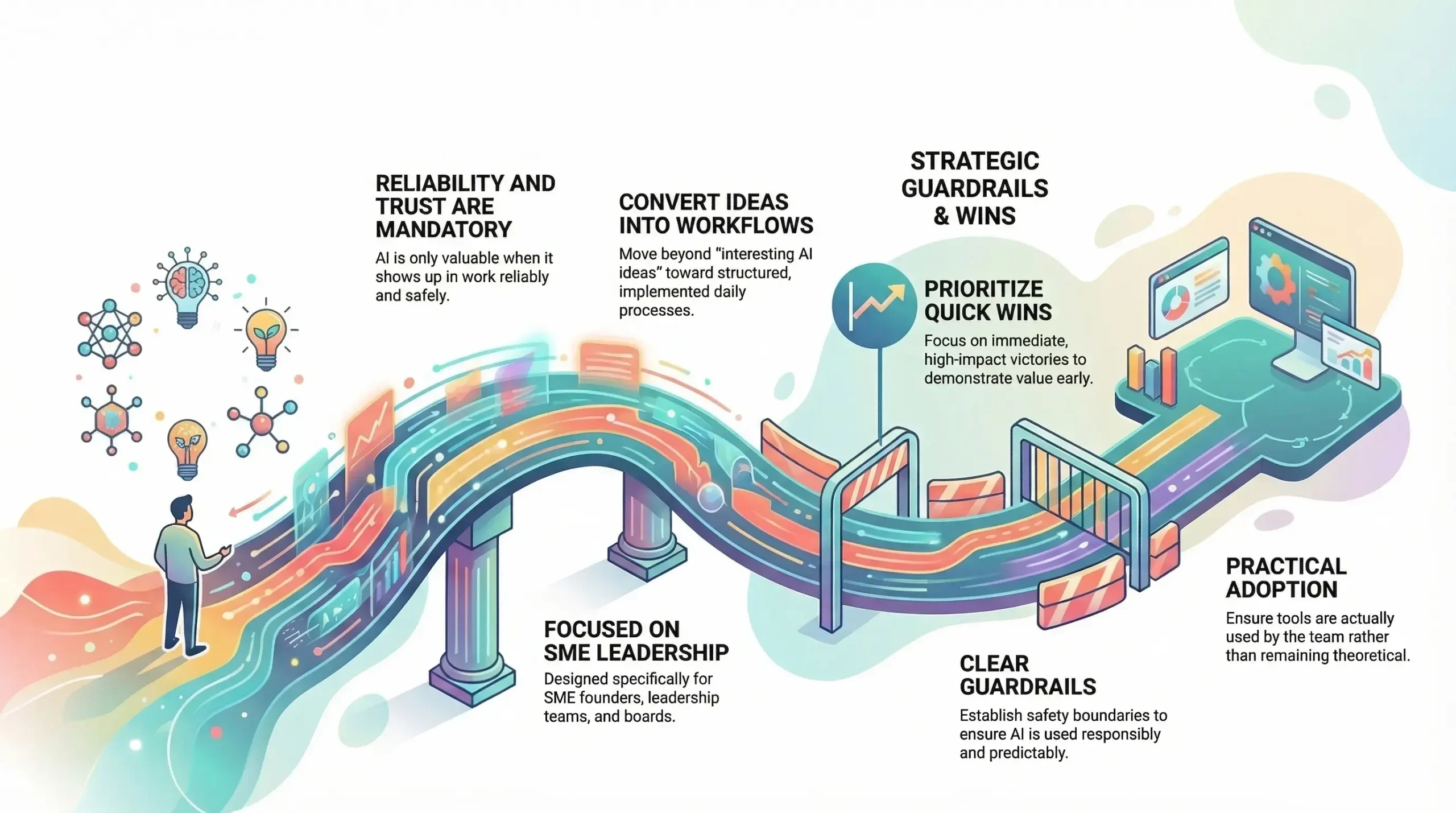
AI is only valuable when it shows up in the work, reliably, safely, and in a way people trust. I help SME founders, leadership teams, and boards turn “interesting AI ideas” into implemented workflows with clear guardrails and quick wins.
The problem I solve
Lots of AI experiments. Not much AI impact.
Teams are trialling tools, but nothing has been standardised.
AI outputs are inconsistent and risky, eroding trust.
Privacy and security questions are left hanging.
There is ambition for AI, but no clear sense of what comes first.
What you get
If you’re saying, “We’re doing a lot, but the needle isn’t moving,” this is probably for you. You’ll walk away with:
- A clear set of priorities
- A value lens (ROI, risk, effort) so trade-offs are obvious
- KPIs/OKRs that make progress measurable and reportable
- A practical roadmap with owners, timelines, and dependencies
- A lightweight execution cadence to keep delivery moving
- A plan your leaders can actually repeat, not just admire
My approach
From “AI curiosity” to “AI capability” in four steps.
Identify
Pick use cases that map to real value and real workflows.
Decide
Test safely, measure impact, and refine quality standards.
Embed
Build SOPs, templates, approvals, and training.
Scale
Expand what works and retire what doesn’t.
Get in touch
Ready to make your next move a smart one?
Let’s Connect!
FAQs
Prompts are part of it, but workflows are the whole system: where AI fits into the process, who uses it, what tools are used, what gets reviewed, and how quality is checked. The goal is consistency, so results don’t depend on one “AI power user”.
We prioritise based on impact (time saved/revenue/quality), effort (complexity/integration), and risk (privacy, customer impact). I’m looking for use cases that are high-value, low-drama, so you get wins early and build confidence.
You’ll never eliminate risk completely, but you can massively reduce it with guardrails: human-in-the-loop review for high-risk outputs, data rules, quality checklists, and prompt patterns that force uncertainty and sourcing. It’s about making the safe path the easy path.
Not necessarily. Many teams can implement strong workflows with tools they already have; the bigger gap is usually operating model, governance, and adoption. If you do need tooling, we’ll choose based on the workflow and risk profile, not shiny features.
We track simple, practical metrics: time saved, cycle-time reduction, quality improvements, conversion lifts, customer response speed, and adoption. If we can’t measure it, it’s usually not ready to scale.