
Key Takeaways
Optimising workflows is essential before pursuing a billion-dollar business model.
The ‘One-Workflow Company’ concept prioritises efficiency over tool accumulation.
Developing a workflow stack map categorises tools and enhances business processes.
Key Answer
Optimising your workflow is crucial before attempting to build a billion-dollar company solo. Focus on creating a single, efficient workflow that automates key decisions to drive business success.
In the world of entrepreneurship, the idea of a one-person billion-dollar company captures the imagination, yet before reaching such dizzying heights, the true challenge lies in building a ‘One-Workflow Company’. This approach focuses on the core automated loop that sustains a business, emphasising operational efficiency as a cornerstone of growth. This article will delve into how optimising workflows can lead to significant financial success, especially for budding entrepreneurs in Australia.
The Foundation of Entrepreneurial Success
Aiming for a billion-dollar company is alluring, but without a robust foundation, such ambitions are merely castles in the sky. In the Australian business landscape, the importance of optimised workflows cannot be overstated. These workflows streamline processes, reduce redundancy, and enable small businesses to scale effectively. The core of this strategy is what experts call the ‘One-Workflow Company’, a principle that prioritises efficient decision-making and task automation over sheer tool acquisition.
The Importance of a Single Automated Workflow
Central to the concept of a ‘One-Workflow Company’ is the creation of a single automated workflow that reduces manual effort and enhances decision-making. By focusing on key recurring decisions that impact revenue, businesses can eliminate bottlenecks. For instance, a Queensland-based start-up might use AI tools to automate lead prioritisation, ensuring every potential customer receives prompt attention without requiring constant manual input.
Expert Perspective
Business Development Specialist
In the dynamic landscape of Australian entrepreneurship, optimising workflows before scaling can be the difference between success and struggle. By focusing on operational efficiency, businesses can establish a solid foundation that supports future growth.
Developing Your Workflow Stack Map
Creating a workflow stack map involves categorising tools for ingestion, processing, and output. This systematic approach ensures that every tool used contributes directly to enhancing workflow efficiency. For example, an Australian business might use a combination of Make.com for low-code orchestration and AI-driven tools like LangChain to automate routine tasks, allowing founders to focus on strategic growth rather than operational details.
Tool Type | Purpose | Example Tools |
|---|---|---|
Ingestion | Capture data from various sources | Forms, APIs |
Processing | Automate decision-making | Make.com, LangChain |
Output | Execute actions based on decisions | Email platforms, CRMs |
Why One Workflow Matters More Than Ten Tools
A lot of businesses are making the same mistake with AI that they made with software.
They keep adding tools.
A CRM here.
An email platform there.
A project management system.
A chatbot.
A content generator.
A reporting dashboard.
A scheduling app.
Each tool promises efficiency. But somehow the business still feels messy.
Why?
Adding tools does not automatically improve the way work moves.
AI does not create leverage just because we use it. It creates leverage when it is attached to a decision that already matters.
For example, saying “we use AI for sales” is too vague.
But saying this is different:
“Every morning, AI reviews new enquiries, summarises each lead, scores them based on fit and urgency, drafts a personalised response, and flags the top five for human review.”
Now we are talking about a workflow.
That is where things become powerful.
A tool helps us do a task.
A workflow helps the business move.
This is the real lesson behind the one-person billion-dollar company idea. It is not really about having no team. It is about increasing the amount of execution one person can direct.
The founder is no longer trying to do everything manually. The founder is designing systems that help the business move without waiting for them at every step.
Start With One Repeated Decision
The best place to start is not the most exciting AI use case. It is the most repeated one.
Look for a decision that happens often, affects revenue or customer experience, and currently depends on manual attention.
A good first AI workflow usually has four qualities.
First, it happens regularly. If something only happens twice a year, it is probably not the place to start.
Second, it uses information you already have. AI works better when the inputs are visible: emails, forms, CRM data, website behaviour, support tickets, order history, or previous customer interactions.
Third, it leads to a clear next action. The workflow should not just produce an interesting summary. It should help something move forward.
Fourth, it can be measured. We need to know whether it improved speed, quality, consistency, or revenue.
A simple example is lead follow-up.
Most businesses say they care about leads. But in reality, lead handling is often inconsistent. Some enquiries get fast replies. Some sit in an inbox. Some receive a generic response. Some are forgotten completely because everyone got busy.
An AI-powered lead workflow could change that.
When a new enquiry arrives, the system could summarise the request, identify the customer type, check whether they match the ideal profile, assess urgency, draft a response, suggest the next step, and remind the business if no one follows up.
The human still makes the important judgment call. But the sorting, drafting, chasing, and remembering no longer depend entirely on human attention.
That is the shift.
We are not removing the founder.
We are elevating the founder.
Instead of touching every small step, we review the moments that matter.
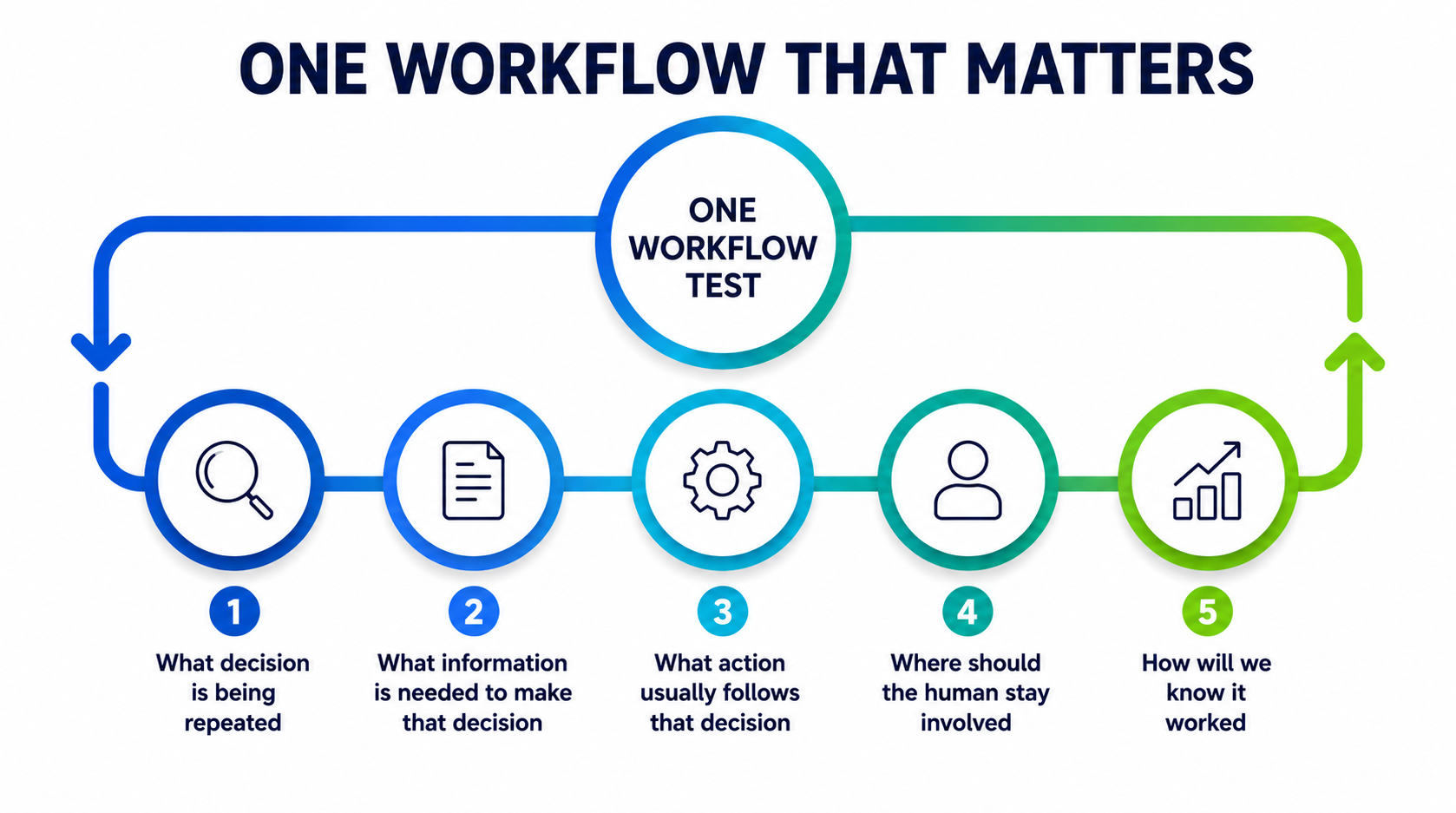
The One-Workflow Test
Before building any AI workflow, I like to bring it back to five practical questions.
1. What decision is being repeated?
Be specific.
Not “sales.”
Not “marketing.”
Not “operations.”
Name the actual decision.
For example:
“Which leads should we prioritise today?”
That is much better than “let’s use AI for sales.”
Once we can name the decision clearly, we can start designing a workflow around it.
2. What information is needed to make that decision?
AI needs context.
For lead prioritisation, that context might include the customer’s industry, company size, location, budget, enquiry source, previous interactions, and urgency.
If the information is scattered, missing, or poorly captured, the AI will struggle.
This is an important point. Sometimes the first step is not adding AI. It is cleaning up the way we collect information.
Bad inputs create bad outputs. AI does not magically fix a messy business process. It usually exposes it.
3. What action usually follows the decision?
A decision without an action is just analysis.
Once a lead is scored, what happens next?
Does an email get drafted?
Is a call task created?
Is the lead moved in the CRM?
Is someone notified?
Is a proposal prepared?
This action layer is what turns AI from a clever assistant into business leverage.
If the workflow does not move anything forward, it is just another dashboard.
4. Where should the human stay involved?
This is critical.
Not every AI workflow should act independently from day one. In most cases, the best starting point is:
AI prepares. Human approves.
Let AI do the sorting, summarising, scoring, and drafting. Let us approve anything that affects revenue, reputation, customer trust, or brand voice.
Over time, once the workflow proves reliable, some low-risk actions can become more autonomous.
But I would not rush that step.
The goal is not to hand over the business. The goal is to remove the low-value friction around decisions we are already making.
5. How will we know it worked?
If we cannot measure the workflow before AI, we will struggle to prove AI improved it.
For lead follow-up, we might measure:
Response time.
Number of leads contacted within 24 hours.
Number of booked calls.
Conversion rate.
Missed follow-ups.
Time saved each week.
Quality of drafted responses.
The goal is not to feel more innovative.
The goal is to improve the business.
If the workflow does not improve speed, quality, consistency, or revenue, it is not leverage. It is theatre.
This Is Where Agentic AI Starts to Matter
In chapter 5 of my book, Think Digital: Rewired for the AI Age, I discuss Agentic AI workflows in more detail, especially how businesses can move from simple automation to systems that can observe, decide, act, and improve over time.
But the place to start is not with the most complex version of that idea.
The place to start is one workflow.
One repeated decision.
One clear set of inputs.
One measurable outcome.
One human checkpoint.
One improvement loop.
That is enough.
Once we get one workflow working properly, we can build the next. Then the next. Over time, the business becomes less dependent on manual effort and more capable of moving intelligently.
That is how small teams start to gain the leverage of much larger companies.
Not overnight.
Not through hype.
Not by replacing everyone.
But by designing better workflows.
Do Not Remove Judgment Too Early
One of the biggest mistakes I see businesses making with AI is moving too quickly from assistance to autonomy.
There are three sensible stages.
Stage 1: AI suggests. It reviews the information and recommends what to do next.
Stage 2: AI prepares. It drafts the email, creates the task, writes the summary, or prepares the quote.
Stage 3: AI acts within limits. It sends updates, schedules, or triggers the next step without needing approval every time.
Most businesses should start at stage two.
That is where the immediate value is. We save time, improve consistency, and keep human judgment in the loop.
This matters because trust is still a business asset.
Customers may not care whether AI helped draft the response. But they will care if the response feels careless, inaccurate, robotic, or tone-deaf.
So let AI handle the preparation.
Let humans handle the judgment.
That balance is where the real power sits.
The Practical Future of AI in Business
The one-person billion-dollar company may be the headline. But for most of us, the real opportunity is simpler and more immediate.
We can build businesses that respond faster.
We can reduce manual follow-up.
We can stop losing opportunities in inboxes.
We can make better use of the data we already have.
We can free ourselves and our teams from decisions that should not need to be remade from scratch every day.
The businesses that benefit most from AI will not be the ones that randomly add the most tools. They will be the ones that understand their workflows deeply enough to know where AI belongs.
So before trying to automate the whole business, start with one repeated decision.
Make it visible.
Give it structure.
Connect it to the right data.
Let AI prepare the next action.
Keep humans involved where judgment matters.
Measure whether the workflow actually improves.
That is how practical AI adoption begins, with one workflow that performs like a reliable team member.
And once we learn how to build one, we can build many.
If this idea resonates with you, I go much deeper into Agentic AI workflows in my book, Think Digital: Rewired for the AI Age.
In the book, I explore how businesses can move beyond basic automation and start building intelligent workflows that learn, adapt, and support better decisions.
Because the future of business is not just about using AI.
It is about rewiring the way we work.
Frequently Asked Questions
Concentrating on one workflow streamlines processes, reduces decision fatigue, and increases operational efficiency, laying a strong foundation for business growth.
AI tools can automate repetitive tasks and improve decision-making processes, allowing businesses to operate more efficiently and focus on strategic goals.
A workflow stack map categorises tools into ingestion, processing, and output, ensuring each tool contributes effectively to workflow optimisation.
Yes, businesses of all sizes can benefit from optimising workflows, though the specific workflows may vary depending on industry and business needs.
Begin by identifying a critical decision that repeats frequently and create a workflow to automate the decision-making process, using AI and low-code tools.