Share this article

Table of Contents

How Do I Know If AI Is Giving Me the Right Answer? An SME's Guide

How Do I Know If AI Is Giving Me the Right Answer? An SME’s Guide

Table of Contents

Key Takeaways

  • AI systems are powerful tools but require diligent verification and human judgement.

  • Understanding AI’s limitations helps in making better business decisions.

  • Cross-referencing and detailed querying enhance the reliability of AI outputs.

Key Answer

To know if AI is giving you the right answer, compare its outputs with multiple sources, request explanations, and use your own expertise. Consider AI as a tool for enhancing, not replacing, human judgement.

Artificial intelligence (AI) is a transformative tool that can significantly enhance business operations by providing insights and streamlining processes in a global marketplace. However, determining whether AI is delivering the right answers is crucial for small to medium-sized enterprise (SME) owners in Australia. This question matters because, while AI offers substantial benefits, it is not infallible. Understanding how to ensure the reliability of AI-generated answers is essential for making informed business decisions. Let’s explore how you can verify the accuracy of AI outputs to benefit your business effectively. For more insights on AI’s impact, you might find What I Got Wrong About AI in 2024, and What Changed Everything in 2025 helpful. Additionally, exploring Leadership – Logan Nathan can provide further guidance on integrating AI into your leadership strategies.

Why AI Gets Things Wrong

AI “hallucinations” occur when the system generates outputs that appear plausible but are incorrect or nonsensical. These errors stem from the AI’s reliance on the data it’s been trained on, which may not always be comprehensive or up-to-date.

Despite its seemingly confident responses, AI can misinterpret queries or lack the contextual knowledge that humans possess. For instance, if the data input is flawed or biased, AI might reflect these inaccuracies in its output.

Understanding AI’s limitations is crucial for business owners, especially those operating within the Australian market. By recognising where AI might falter, you can make informed decisions about when to lean on technology and when to rely on human insight. This balance is vital for SMEs aiming to optimise their operations while maintaining a human touch.

Should I Trust AI or Verify It in a Global Marketplace?

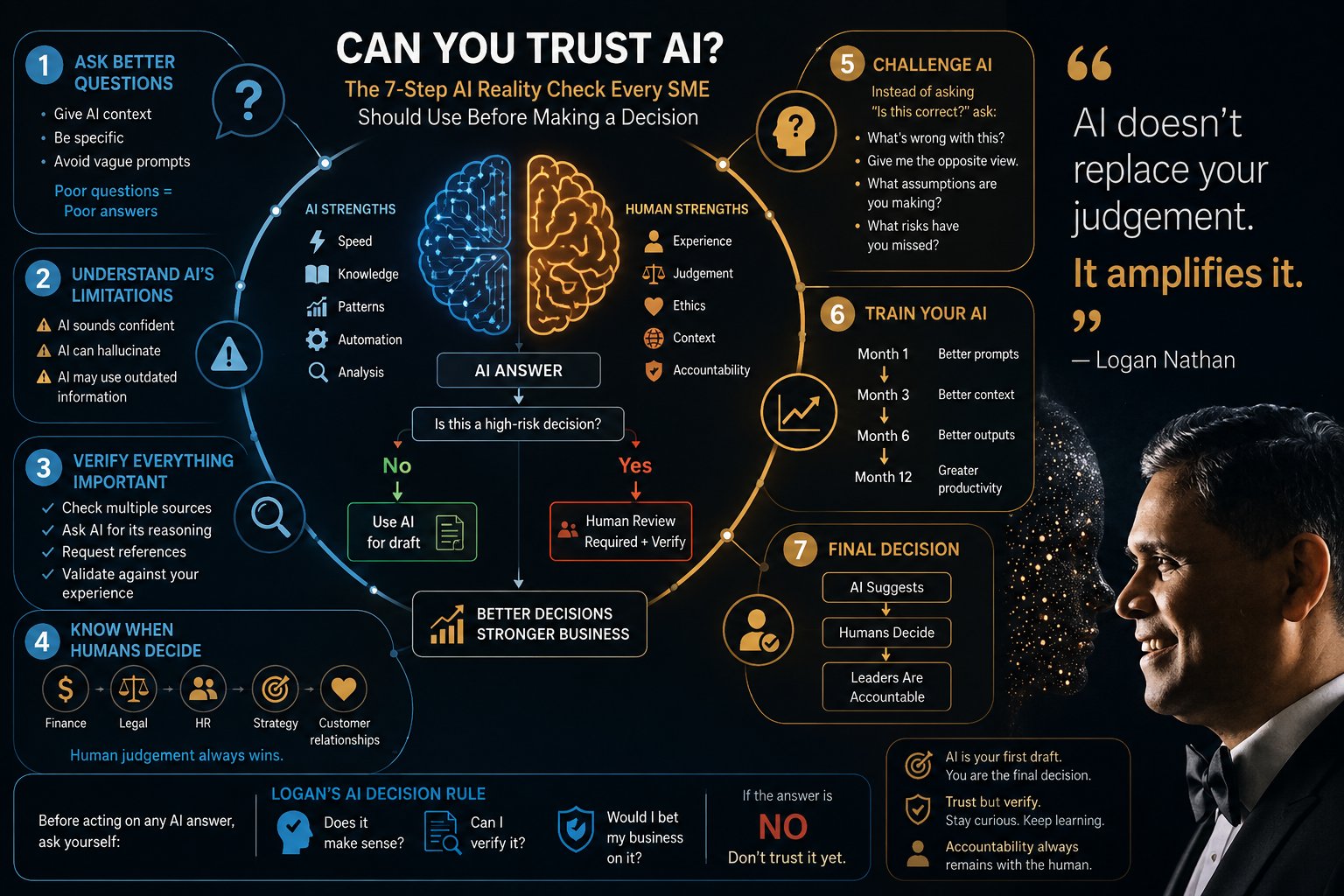
AI is reliable in scenarios involving pattern recognition, data analysis, and routine task automation. However, its reliability decreases when handling nuanced, dynamic, or ethically significant tasks.

Every AI-generated answer should be independently verified when it pertains to high-stakes decisions such as financial forecasting, legal advice, or strategic planning. These are areas where mistakes could have significant repercussions.

Decisions in fields like finance, law, and human resources should never solely rely on AI. Human oversight ensures that ethical considerations and nuanced judgement are applied.

My Personal Experience…

as an AI Integration Specialist

In my experience, AI should serve as an augmentation tool rather than a replacement for human insight. Its strength lies in pattern recognition and data processing, but for nuanced decision-making, human judgement remains irreplaceable. As SME owners in Australia, we must remain vigilant, constantly validating AI’s inputs and outputs to truly harness its potential. This vigilance ensures that AI complements rather than compromises our business strategies.

Am I Asking the Right Question?

The quality of the answers you receive from AI heavily depends on how you phrase your queries. A well-crafted prompt should be clear, precise, and provide all necessary context.

When engaging with AI, it’s crucial to supply detailed information. Contextual details help the system understand the nuances of your request.

For example, specifying ‘local Australian market trends in 2023’ will yield more relevant insights than a vague query about market trends. This specificity helps AI provide the most accurate and useful information. By tailoring your queries to the Australian context, you enhance the relevance and applicability of AI-generated insights.

How Can I Validate AI's Answers?

To ensure accuracy, compare AI’s outputs with information from multiple trusted sources. Cross-referencing helps identify any discrepancies or errors.

Ask the AI to elaborate on its reasoning. This can reveal the logic behind its conclusions and help you assess the reliability of the information.

Always request references and scrutinise the sources AI cites. Use your own business knowledge to evaluate whether the AI’s outputs make sense within your industry context. For Australian SMEs, this means ensuring that AI insights align with local market conditions and regulatory frameworks.

When Should Human Judgement Override AI?

In scenarios requiring ethical judgement or strategic foresight, such as financial decisions or legal matters, human intervention is essential.

For HR and people-related decisions, AI can offer valuable data, but human judgement is irreplaceable in understanding personal nuances and emotions.

Customer complaints and strategic business decisions demand a human touch to appropriately assess situations and make decisions that align with company values.

How Can I Reduce AI Mistakes?

To minimise errors, provide AI with clear and concise instructions, breaking down complex issues into manageable parts.

Engage in a dialogue with the AI, asking follow-up questions to clarify any ambiguities.

Challenge AI to identify weaknesses in its own responses. This practice not only enhances accuracy but also helps in building a more robust AI toolset for your business.

Can AI Help Me Think Better Instead of Thinking for Me?

AI excels as a brainstorming partner, enabling you to explore various assumptions and alternatives. Use it to refine your ideas rather than generate them entirely.

By testing different scenarios and outcomes, AI can augment your decision-making process, providing a broader perspective without overshadowing your judgement.

What Is the Best Mindset When Using AI?

Approach AI as your initial draft rather than your definitive solution. This mindset allows you to leverage AI’s capabilities while maintaining control.

Trust but verify: always confirm AI’s outputs with your knowledge and other sources.

Stay curious and open to learning. As AI evolves, so too should your approach to using these tools in your business. Remember, the ultimate accountability lies with you, not the AI.

Case Study: My Journey with AI

My personal experience with AI underscores the importance of selecting a dedicated engine that complements your business needs. After more than 12 months of training my AI tool to align with my preferences, I noticed significant improvements in task efficiency. This journey highlights the value of patience and persistence in integrating AI into your business operations.

I focused on using ChatGPT as my primary assistant, ensuring privacy settings were optimised to protect personal and business information. This tailored approach maximised the tool’s potential in supporting my daily operations.

Remember, the key is not just in choosing the right tool, but in patiently training it to understand your unique requirements and privacy concerns.

Frequently Asked Questions

AI hallucinations are errors where the AI generates plausible-sounding but incorrect or nonsensical outputs.

Compare AI outputs with multiple trusted sources, ask for detailed reasoning, and use your business expertise to assess the information.

Human judgement should override AI in high-stakes decisions like finance, legal, HR, and strategic business decisions.

Provide clear instructions, break down complex tasks, and engage in dialogue with AI to clarify outputs and address errors.

Approach AI as an initial draft, trust but verify its outputs, stay curious, and remember that final accountability rests with you.

Understanding AI’s limitations is crucial for making informed decisions about when to rely on technology and when to apply human insight, especially in areas requiring ethical judgement and strategic foresight.

AI excels as a brainstorming partner by enabling exploration of various assumptions and alternatives, helping refine ideas without overshadowing human judgement.

AI hallucinations are errors where the AI generates plausible-sounding but incorrect or nonsensical outputs.

Compare AI outputs with multiple trusted sources, ask for detailed reasoning, and use your business expertise to assess the information.

Human judgement should override AI in high-stakes decisions like finance, legal, HR, and strategic business decisions.

Provide clear instructions, break down complex tasks, and engage in dialogue with AI to clarify outputs and address errors.

Approach AI as an initial draft, trust but verify its outputs, stay curious, and remember that final accountability rests with you.

#AIIntegration #SMEBusiness #AIValidation


Powered by iBeVisible