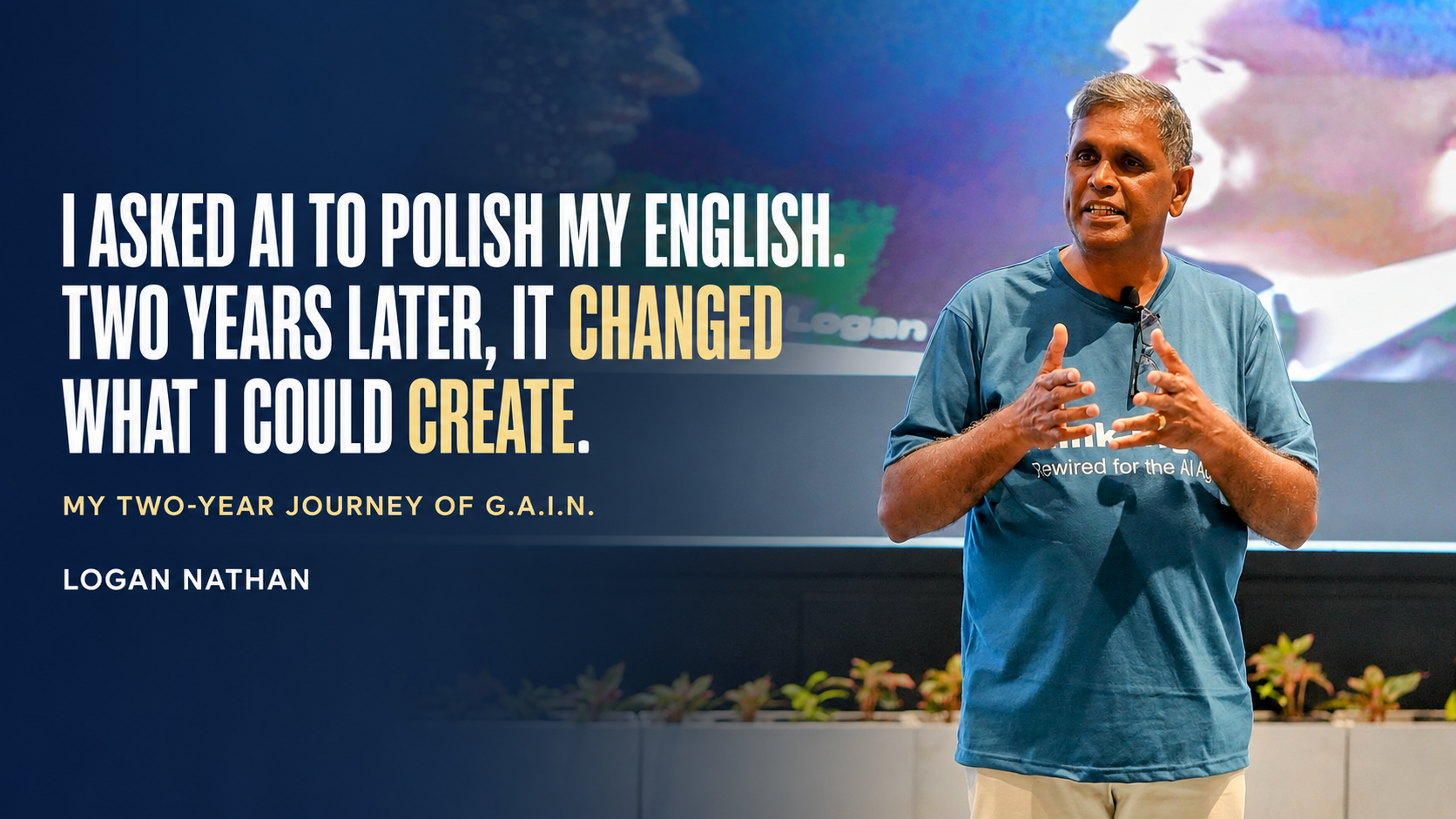
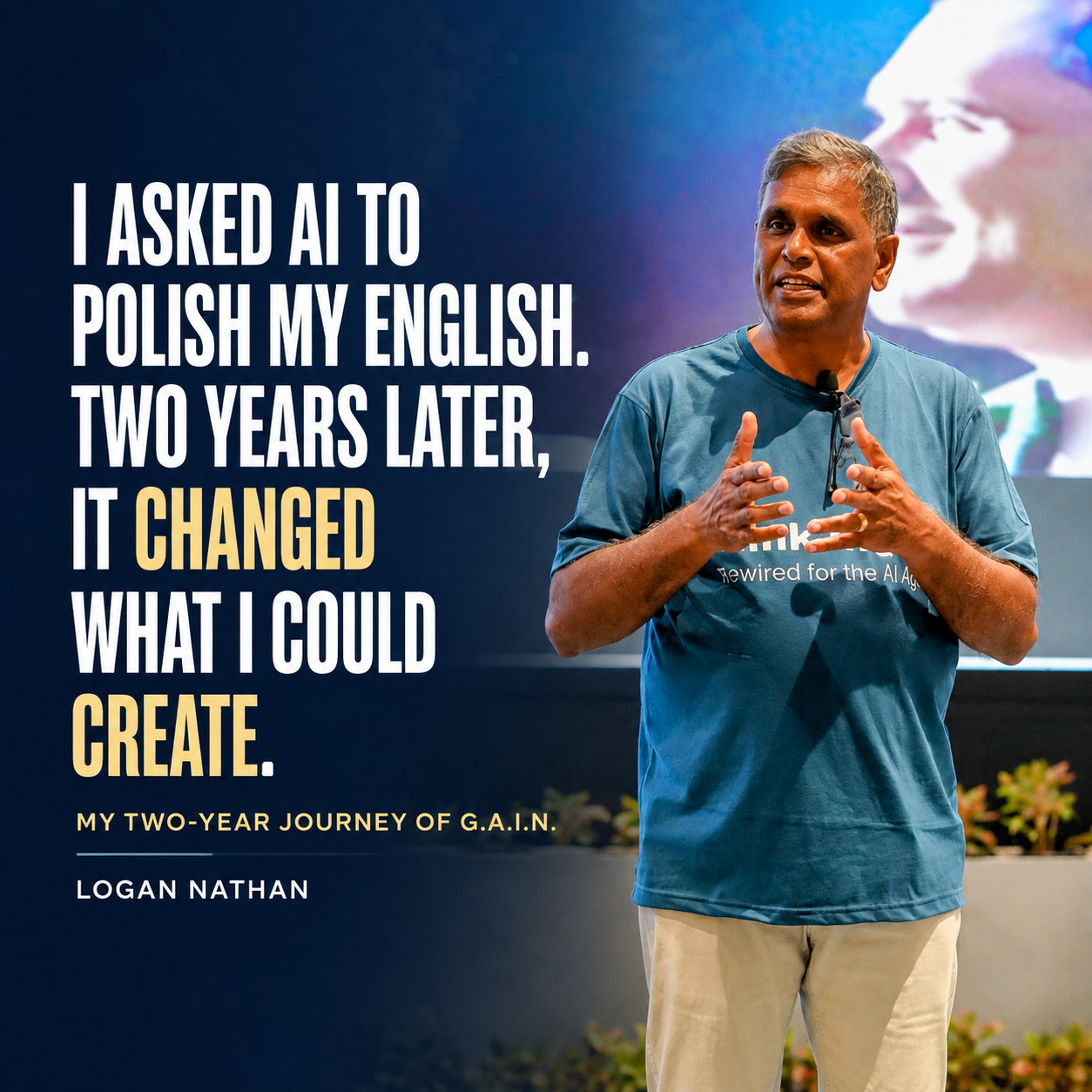
Logan Nathan's Two Year Journey of AI G.A.I.N - A Case Study
My journey from clearer writing to books, music, multimedia storytelling, an SME platform and a trilingual guide for Sri Lanka’s next generation
In 2024, my expectations of artificial intelligence were quite modest.
English is not my mother tongue. I grew up speaking Tamil and Sinhala in Sri Lanka before continuing my education and career internationally.
When I began using ChatGPT, I was excited that it could polish my English. I could concentrate on the experience or idea I wanted to share while AI helped improve the grammar, structure and flow.
That alone was valuable.
I had spent more than four decades working in technology, business transformation and entrepreneurship. I had plenty of experience to draw from, but turning that experience into clear written communication still took time.
AI began by helping me find the right words.
I did not expect where it would take me next.
From words to visual thinking
About three months later, I discovered that AI could also help me create images and, more importantly, infographics.
This changed how I thought about communication.
A long explanation could be transformed into a visual that people could understand within minutes. Business frameworks, lessons from experience and complex ideas about technology could be presented in a simpler and more accessible form.
I was no longer limited to writing.
Another three months passed, and I began combining my own photographs with written articles, graphics and visual storytelling.
A photograph from an event was no longer simply a record of my attendance. It could become the starting point for a reflection, article, social post or visual summary of what I had learned.
My work was beginning to move across different forms.
Discovering music as another language
A few months later, I found that AI could help me write lyrics and turn them into music.
This opened another door.
Music can carry emotion, humour, culture and memory in ways that ordinary writing cannot. Through lyrics and sound, I could express stories from Sri Lankan life, family experiences and community events in a form that people could feel as well as understand.
I began to see that the same idea could live as an article, image, infographic, song or video.
Each format reached people differently.
Capturing a complete human experience
The next stage brought these capabilities together.
I could attend an event, observe what happened and reflect on its human meaning. I could then:
- write a summary or article
- select and organise photographs
- create a visual story
- write lyrics based on the experience
- generate music that matched its emotion
- produce a video combining the words, images and sound
- share the message with family, friends, professional networks and wider communities
Work that once required a writer, designer, musician, video producer and editor could now be explored by one person working with AI.
That does not mean AI replaced those creative professionals. Their experience and craft remain valuable, particularly when professional production quality is required.
AI gave me the ability to take an idea much further before needing a larger team.
It shortened the distance between experience and expression.
Returning to my passion for writing books
By May 2025, AI had helped me reconnect with an earlier passion: writing books.
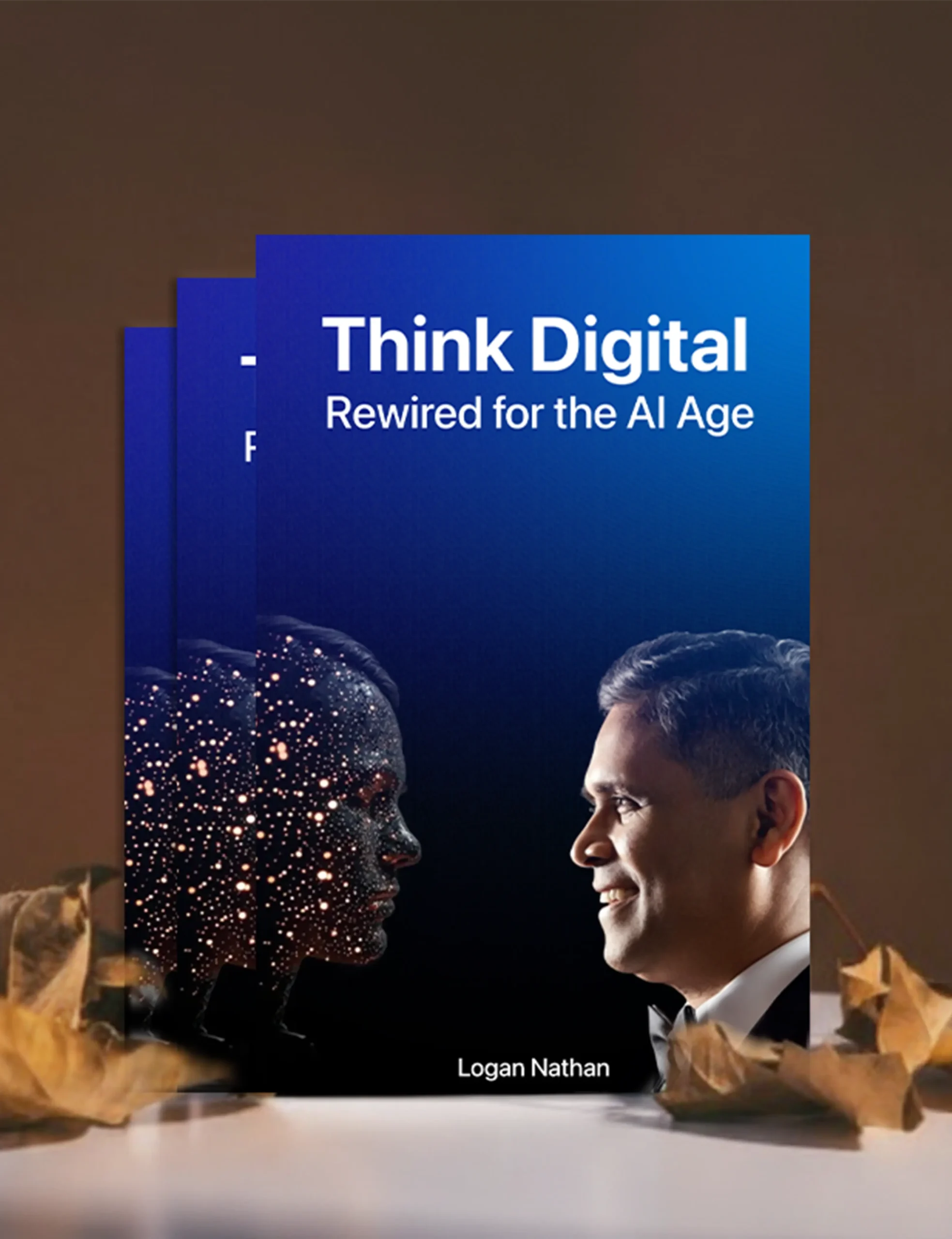
My first book, Think Digital, was published in 2015 to help business owners understand how technology could help them grow, compete and rethink traditional ways of working.
Ten years later, generative AI had changed the technology landscape again.
With the help of AI and the practical contribution of my work colleagues, I returned to those earlier ideas and began writing Think Digital: Rewired for the AI Age.
This became my first AI-assisted book.
It was not written from theory. It drew on what my teams and I were learning through the practical use of AI inside our businesses.
The book explored a question many leaders and business owners were beginning to ask:
How should we respond when AI is changing not only our technology, but also how we think, work, communicate and compete?
AI helped me research, organise, structure and refine the material. My colleagues contributed examples, practical knowledge, challenges and different perspectives.
But the experience, judgement, stories and central message remained human.
The book was published in 2025 and is now selling globally.
AI helped me return to writing, but it did not replace the author. It helped the author work differently.
From a book to an AI platform for SMEs
By January 2026, another idea had begun taking shape.
My team, and I had been experimenting with AI to improve content creation, writing, images, publishing and consistency inside our businesses.
Through that work, we saw a growing problem facing SMEs.
Customers were no longer discovering businesses only through traditional search engines. They were beginning to ask ChatGPT and other AI platforms for answers, comparisons and recommendations.
A capable business might deliver excellent work yet remain almost invisible if its expertise, evidence and authority could not be found or understood by these new systems.
That practical problem led to the development of iBeVisible, an AI-powered platform designed to help SMEs strengthen their visibility, authority and digital presence.
The platform remains a work in progress. It is already being used by people and businesses in several parts of the world, but its long-term value will be determined by the results it produces over time.
I believe it has the potential to become a winner not because it uses AI, but because it is being built around a genuine business problem.
This reflects a principle that has guided my work for many years:
Don’t start with AI. Start with the business problem. Improve the process first, then determine where AI can genuinely create value.
Sri Lanka changed the direction again
The next part of the journey brought me back to where my own story began.
During presentations and conversations around Sri Lanka, I saw great curiosity about AI, particularly among young people.
But I also saw uncertainty.
Students wanted to understand what AI would mean for their future. Parents and teachers were trying to work out how to guide them. Many could see that technology would change education and employment, but they did not know what young people should do to prepare.
Those conversations stayed with me.
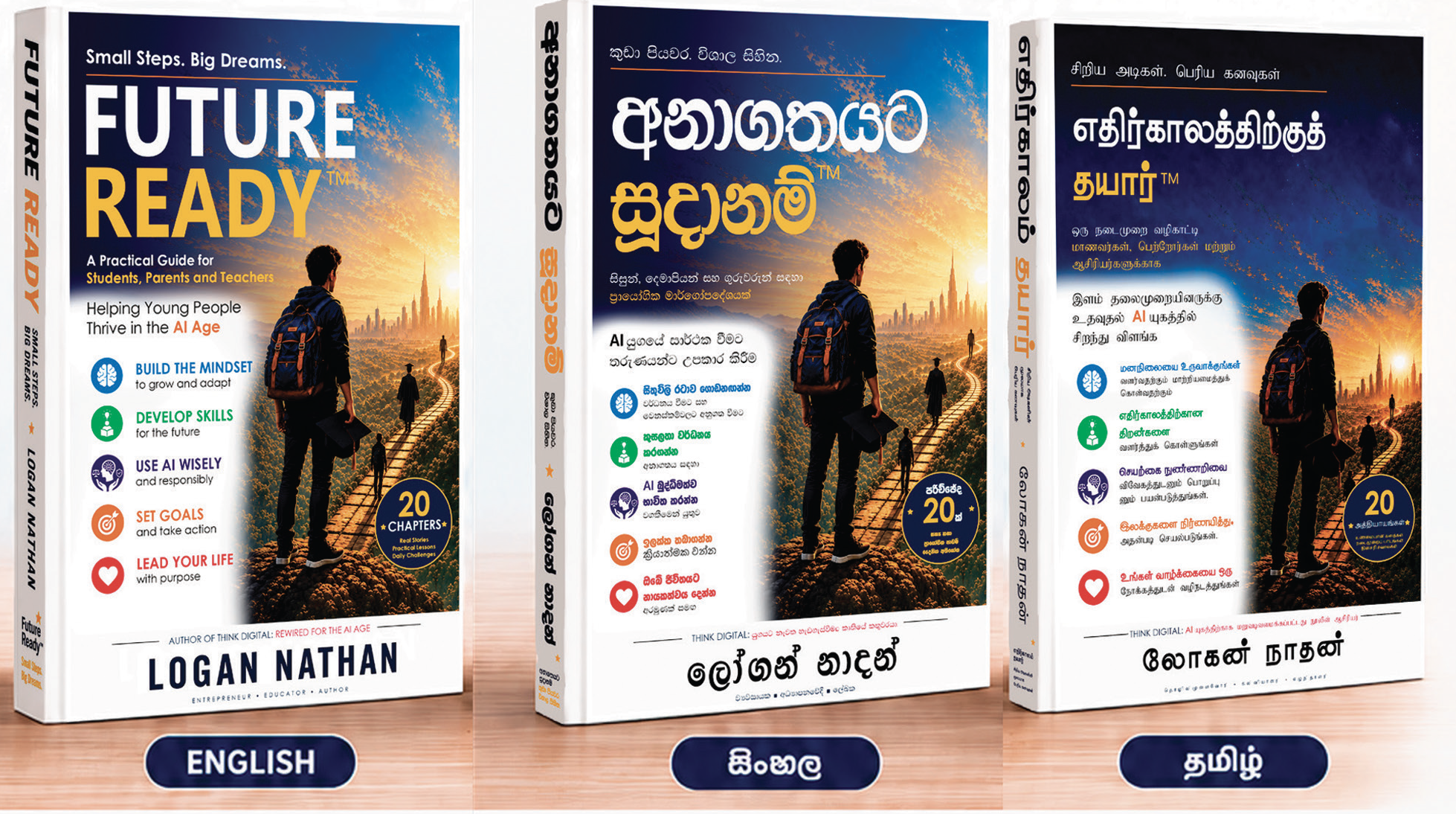
They led me to write FUTURE READY™ — Small Steps. Big Dreams. Helping Young People Thrive in the AI Age, a practical guide for students aged 10 and above, parents and teachers.
I decided that the book had to be available in three languages:
- English, providing broader international access
- Tamil, my mother tongue
- Sinhala, the language I grew up with in Sri Lanka and the language spoken by many of my work colleagues
This was not simply a translation exercise.
Sri Lanka’s future belongs to children from every community. Access to practical knowledge about AI should not be determined by language, location or family circumstances.
The purpose of the book is not to turn every child into an AI engineer.
It is to help young people become confident learners, thoughtful problem-solvers and responsible users of technology with parents and teachers supporting them along the way.
AI helped make this ambitious trilingual project more achievable. Once again, however, human contribution remained essential.
Translators, reviewers, educators, colleagues and community members brought the cultural understanding and judgement that technology alone could not provide.
AI became more than a productivity tool
When I look back over these two years, I can see a clear progression.
AI first helped me write more clearly.
Then it helped me think visually.
It helped me combine photographs and words, express emotion through music, capture events through multimedia, return to writing books, build an AI platform for SMEs and create educational material for Sri Lanka’s next generation.
But something else happened.
The body of work I created began to reveal patterns:
- the subjects I repeatedly return to
- the way I connect experience with practical lessons
- my preference for solving real problems
- the importance I place on people and human relationships
- my connection with both Australia and Sri Lanka
- my interest in helping SMEs and young people prepare for the AI age
AI became a kind of mirror.
It could recognise patterns across my writing, projects and conversations and help me express new ideas more consistently in my own voice.
I would describe it as a thinking and creative partner not a human life partner. AI does not possess emotion, lived experience or genuine human understanding.
It can recognise my patterns.
Only I can decide what they mean.
What did I G.A.I.N.?
When people discuss AI productivity, they usually focus on time saved.
My own experience has been much broader.
I now describe it through a simple framework: G.A.I.N.
G - Get things done faster
I can complete familiar work in less time.
Writing, researching, summarising and structuring material no longer need to begin with a blank page. AI can help me develop a first draft, test an idea or organise information quickly.
This is the traditional efficiency gain most people associate with AI.
A - Amplify the message
I can communicate the same idea through writing, photographs, infographics, music and video.
A message that may not reach someone through a long article might connect through a visual, a short video or a song.
AI helps me adapt the message without losing its underlying purpose.
I - Increase my capacity
I can produce more without needing a large creative or production team for every early-stage idea.
This does not remove the need for skilled people. It allows me and my colleagues to explore, test and improve ideas before deciding where specialist expertise is required.
The team can spend less time assembling basic material and more time applying judgement, creativity and experience.
N - New capabilities unlocked
This has been the most significant gain.
I can now create work in forms that were previously beyond my personal skills.
Writing an article in half the time is an efficiency gain.
Turning the same experience into an article, infographic, song and video is a new capability.
That is not merely doing the same work faster.
It is expanding what one person can imagine, create and share.
More than 50% efficiency?
I believe AI has reduced the time required for some of my writing and creative communication workflows by more than 50%.
But a single productivity number does not fully explain what has happened.
If I produce an article in half the time, the improvement can be measured reasonably easily.
But how do I calculate the gain when I can now turn that article into an infographic, translate it into another language, write lyrics around its central idea and communicate it through music and video?
The real gain is not only efficiency.
It is a combination of speed, clarity, capacity and newly accessible skills.
That is why the G.A.I.N. framework provides a more honest picture than one percentage alone.
Three channels of human expression
Much of my AI-assisted work now combines three communication channels:
- Visual: photographs, images, infographics and video
- Auditory: speech, lyrics, music and sound
- Experiential: movement, interaction, participation and learning by doing
AI does not experience these senses as humans do. It cannot smell, taste, feel or understand the emotional meaning of a moment.
The human being remains the observer.
The technology helps capture, organise and communicate what the human being experienced.
What I have learned
I began this journey by asking AI to improve my English.
Two years later, it has helped me discover new ways to communicate what I have learned over a lifetime.
It has supported my return to authorship, helped my team develop a global AI platform for SMEs and made a trilingual educational initiative for Sri Lanka’s young people more achievable.
The technology has undoubtedly changed.
But so have I.
AI did not create my experience, values or purpose. It helped me recognise them, connect them and express them through words, images, music and video.
The greatest value of AI is not that it can think for us.
It is that, when used thoughtfully, it can help us understand our own thinking and turn what we have learned into something useful for others.
That is what I have truly G.A.I.N.ed.