

Key Takeaways
- The transition to the AI Age is marked by a shift from capital investment to adaptability as a key competitive advantage.
- Adaptability, creativity, and continuous learning are emerging as essential skills in the AI-driven economy.
- AI technologies offer smaller nations and businesses unprecedented opportunities by lowering barriers to entry.
Key Answer
The Industrial Age rewarded capital, focusing on physical assets like machinery. The AI Age prioritises adaptability, emphasising skills such as creativity and learning, essential for navigating the future.
The Industrial Age rewarded capital. The AI Age rewards adaptability. This pivotal shift compels us to rethink the dynamics of success in today’s rapidly evolving global economy. The historical transition from capital-intensive industries to those driven by adaptability marks a significant transformation in how wealth and power are distributed and maintained.
The Evolution of Economic Eras
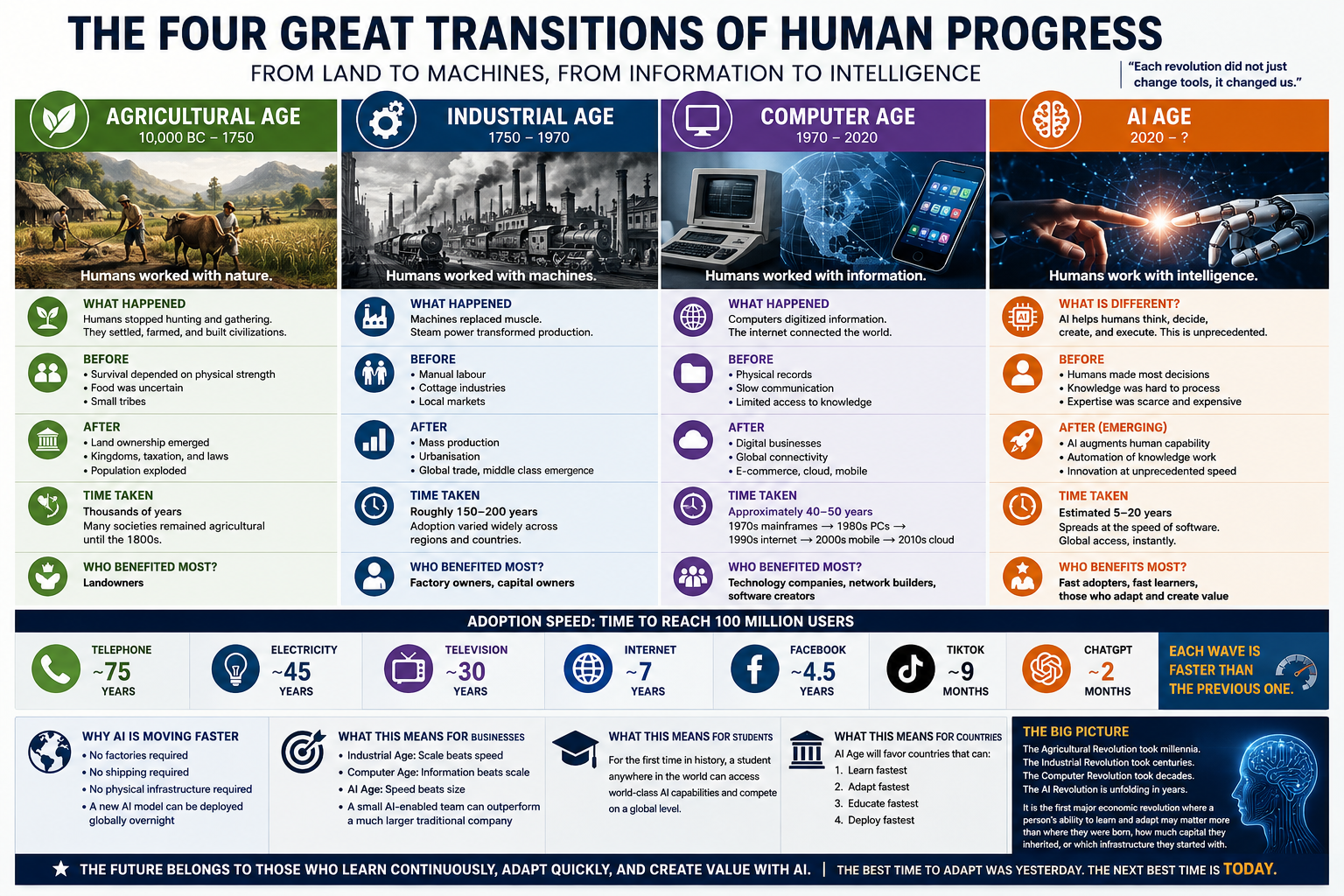
Human history has been marked by distinct economic eras, each reshaping society in profound ways. The Industrial Revolution was a period where capital investment in physical assets dictated business success. Factories, heavy machinery, and physical infrastructure were the hallmarks of this time, giving rise to powerful industrial giants. However, as we transition into the AI Age, the emphasis shifts from tangible assets to the intangible capability of adaptability.
Adaptability in the AI Age refers to the capacity to quickly learn, innovate, and apply new skills. This shift is significant for business leaders, policymakers, and educators alike, as it influences how we prepare for future challenges and opportunities. The once dominant power of capital investment is being replaced by the ability to navigate rapid technological changes.
The Rapid Pace of Technological Advancement
The progression from the Industrial Age to the AI Age has been marked by a swift acceleration in technological advancements. While the Industrial Revolution unfolded over centuries, advancements in AI and digital technologies occur over mere decades, sometimes even years. This rapid development is largely due to the digital nature of AI, which facilitates quick global dissemination of innovations.
For businesses, this means that the ability to adapt and implement new technologies faster than competitors is crucial. The digital nature of AI allows even smaller nations and companies to compete on a global scale, without the hefty capital investment that was previously required.
Expert Perspective
Global Business Strategist
The AI Age challenges traditional business models, demanding a new emphasis on adaptability. As a global business strategist, I see the need for a shift in focus from accumulating capital to nurturing human capabilities. This shift not only benefits organisations but also creates a more dynamic and resilient workforce prepared for the challenges of tomorrow’s economy.
AI Adaptability: The New Competitive Edge
In the AI Age, adaptability has become synonymous with competitiveness. As AI technologies continue to evolve, the ability to adapt quickly to new trends and technologies becomes invaluable. For SMEs and other organisations, embracing adaptability can lead to significant competitive advantages, allowing them to stay ahead of the curve.
21st-century skills such as critical thinking, problem-solving, and creativity are more important than ever. These skills enable individuals and organisations to make the most of AI advancements. Companies that prioritise learning and adaptability are better positioned to leverage AI for innovation and efficiency.
Preparing for the AI Age: Skills and Strategies
To thrive in the AI Age, organisations and individuals must focus on developing adaptability. This involves fostering an environment that encourages continuous learning and innovation. Educators are now tasked with integrating skills for the 21st century, such as digital literacy and emotional intelligence, into curriculums.
For business leaders and policymakers, creating policies and strategies that promote an adaptable workforce is imperative. This includes investing in training programs that equip employees with the necessary skills to navigate technological changes effectively. As AI continues to reshape industries, the ability to pivot and adapt becomes not just a competitive advantage but a necessity for survival.
The Impact on Global Economies
The AI Age offers unprecedented opportunities for smaller nations to participate in the global economy. With lower barriers to entry, these countries can leverage AI technologies to build robust, competitive economies. By focusing on adaptability and innovation, smaller nations can position themselves as leaders in this new economic era.
For larger economies, the shift towards AI adaptability requires restructuring traditional economic models to prioritise innovation over capital investment. Governments that embrace these changes and encourage adaptability are likely to see significant economic growth and resilience.
Frequently Asked Questions
AI reduces entry barriers, enabling businesses of all sizes to compete by leveraging cutting-edge technology without substantial capital investment.
Adaptability allows individuals and organisations to respond swiftly to technological changes, ensuring they remain competitive and successful.
Skills such as creativity, critical thinking, and continuous learning are essential for navigating the challenges and opportunities presented by AI.
Smaller nations can harness AI to build competitive economies with fewer resources, focusing on innovation and adaptability.
Governments can facilitate AI integration by promoting innovation and adaptability, ensuring equitable growth and opportunities.