
Navigating an Unpredictable World
In a world where artificial intelligence reshapes every aspect of life, from education to the workplace, being prepared for the future is more about flexibility than having all the answers. According to the World Economic Forum, the skills that individuals need are shifting more rapidly than ever. It’s not just about learning new skills; it’s about developing an agile mindset capable of adapting to changes that we cannot yet foresee. The duck family’s journey is a poignant reminder of this need for adaptability. As educators and parents, our role is not to control every step our young people take, but to guide and support them in learning how to navigate through their unique challenges. We provide the initial direction, but they must learn to make their own choices, just as the ducklings did.
Learning Through Experience
Young people need opportunities to question, experiment, and make mistakes. These experiences are the building blocks of judgement and resilience. In the context of AI, they need to understand how to use these tools to complement their thinking, not replace it. The aim should be to foster independent thought processes rather than an over-reliance on technology. A balanced approach is essential. AI can offer immense support in learning, providing explanations and suggestions that can open up new perspectives. However, students should first engage with problems independently before turning to AI for guidance. This strategy ensures that AI serves as a valuable co-pilot rather than an autopilot that does the thinking for them.
My Perspective
AI Advocate / Education Consultant
In my years of observing and guiding young minds, I’ve seen firsthand that adaptability and resilience are not just beneficial skills but essential ones. These capabilities allow our youth to transform challenges into opportunities, making them not just ready for the future, but masters of it.
Building Resilience and Adaptability
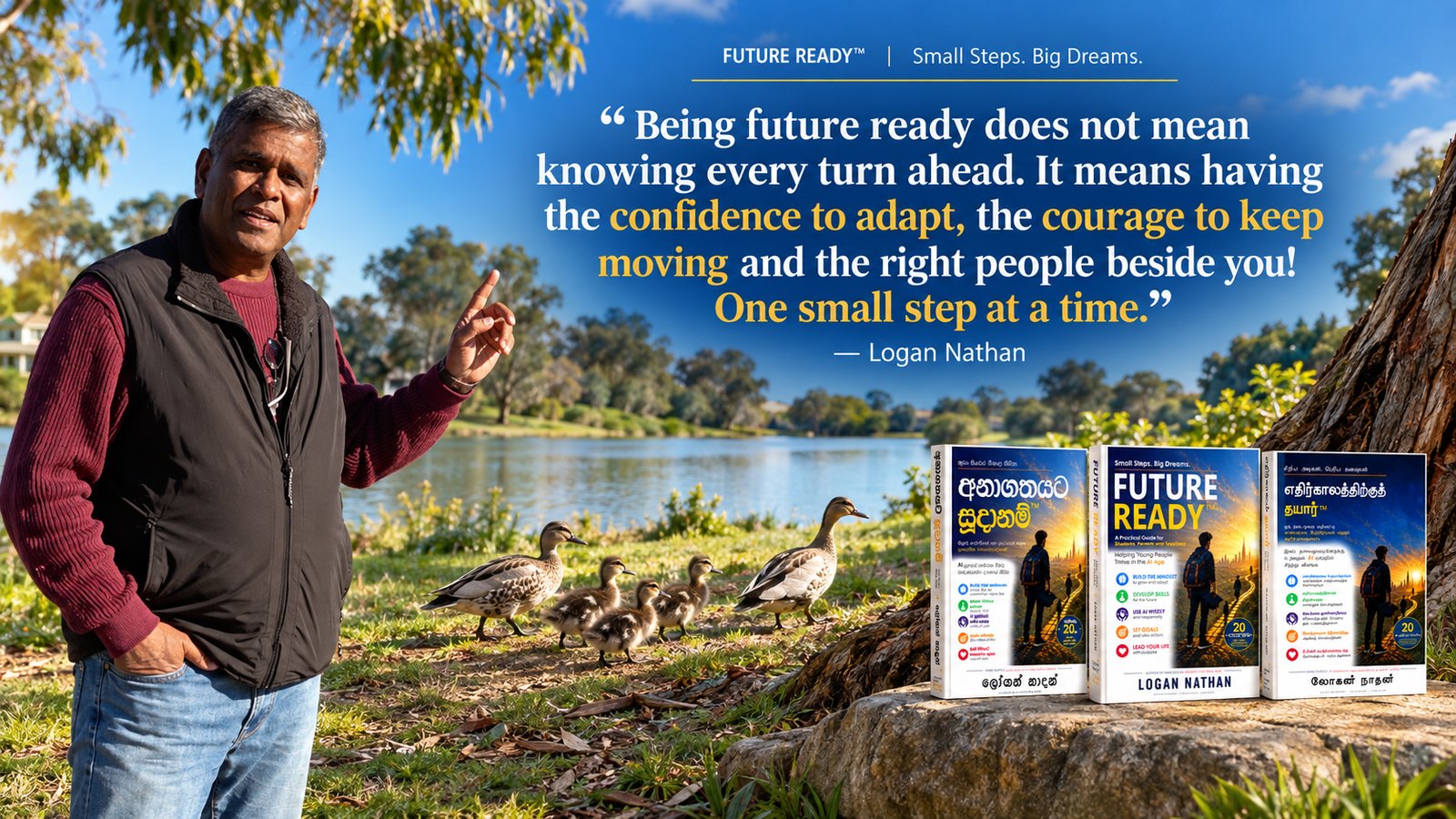
The tree blocking the ducks’ path symbolises the unexpected obstacles that life often presents. Moving around requires resilience and adaptability, key attributes for tackling larger challenges.From my personal experience “Being future ready does not mean knowing every turn ahead. It means having the confidence to adapt, the courage to keep moving, and the right people beside you. One small step at a time “
Small, consistent steps build confidence. Just as the ducks regrouped after navigating around the tree, young people should learn to regroup after challenges, reinforced by the support of those around them. Whether in Australia, Sri Lanka, or globally, this collective approach ensures no one walks the path alone.
Fostering a Supportive Environment
Readiness for the future is not achieved in isolation. Just as the ducks moved together, young people need to be surrounded by a supportive network that encourages exploration and growth. Educators and parents play a vital role in crafting this environment, offering guidance while allowing room for independent growth.
Building this support network also includes teaching young people about the value of community and social capital as a safety net. Strong, collaborative communities can offer resilience against global and local instabilities, much like the adult ducks providing safety and guidance for the young ones.
Looking Forward: FUTURE READY™ - Small Steps. Big Dreams.
As I prepare to release my upcoming trilingual book, FUTURE READY™–Small Steps. Big Dreams., I am reminded of the importance of equipping our young people with the right tools and mindset to face an uncertain future. Scheduled for release in October 2026, this book aims to provide practical guidance for students, parents, and teachers.
It is not about dictating a single path forward but offering insights into how to embrace the unknown. By understanding the balance between guidance and independence, and fostering resilience and adaptability, young people can confidently step into their futures, ready for the challenges and opportunities that await.
Taking Action
The journey of the duck family teaches us that while we cannot always predict the path ahead, we can prepare our young people to take it one confident step at a time. Adapting to change is not just a skill but a necessity in the modern world.
Incorporating these lessons into our daily lives, educational systems, and family dynamics can transform how young people perceive and respond to the future. By doing so, we lay the groundwork for a generation equipped not just to survive but to thrive in an uncertain world.
To explore further how our educational approaches can be refined in this AI-driven age, visit Why Teens Must Master AI for Future Success | Future Insights. Additionally, learning about the evolution from industrial capital to AI adaptability can provide deeper insights, which is detailed at The Industrial Age Rewarded Capital. The AI Age Rewards Adaptability. | Insightful Business Guide.
Final Thoughts
As we reflect on the journey ahead, it is clear that the path is fraught with challenges but also rich with potential. Our role is to prepare young people not for a specific set of circumstances, but for the inevitability of change. With each small step, guided by support and bolstered by resilience, our youth can navigate an uncertain future with confidence.
Frequently Asked Questions
How can young people prepare for an uncertain future?
Young people can prepare by developing adaptability and resilience, learning to use AI as a tool, and surrounding themselves with a supportive network.
What role do parents and teachers play in preparing youth for the future?
Parents and teachers should guide and support young people, encouraging independent thinking and providing a safe space for experimentation and growth.
Why is it important not to depend too heavily on AI?
Over-reliance on AI can hinder critical thinking and independent problem-solving. AI should complement the learning process, not replace it.
What can be learned from the duck family metaphor?
The metaphor highlights the importance of adaptability and resilience. It shows how young people, like the ducks, can navigate challenges with support and confidence.
How does community support enhance future readiness?
A strong community provides a safety net and resources, offering emotional and practical support that fosters resilience and adaptability.
—