
Share this article

Table of Contents

Small Steps to Dream Big for our AI Future Readiness: A Global Perspective

Small Steps to Dream Big for our AI Future Readiness: A Global Perspective

Table of Contents

Key Takeaways

  • Small steps are essential for achieving future readiness in an AI-driven world.

  • Intergenerational collaboration can bridge the technology gap between youth and older generations.

  • Daily micro-actions in skill acquisition build towards larger professional goals.

Key Answer

In today’s AI-driven world, small steps towards skill acquisition and adaptability are the key to future readiness. Embracing these gradual changes allows youth to harness technological advancements and realise their greatest dreams.

In a world constantly reshaped by technological advancements, the phrase “small steps take us dream big in our future readiness” encapsulates a powerful strategy for navigating the complexities of tomorrow. As a child, I relied on the guidance of parents and teachers, a network of support that seemed unshakeable. Yet, as technology evolved from mainframes to today’s ubiquitous smartphones, the landscape of learning and preparation has shifted dramatically.

The Evolution of Technology: From Mainframes to AI

Growing up, the guidance I received was rooted in traditional frameworks, which are family discussions around the dining table and classrooms led by teachers with chalk in hand. Technology at that time was a behemoth, restricted to mainframes. As decades passed, we witnessed a transformation as technology shrunk from mainframes to desktop computers and finally into the palm of our hands. This evolution didn’t just change how we access information; it redefined how we interact with the world around us.

Now, we stand at the precipice of a new era, one defined by Artificial Intelligence (AI). AI is not merely a tool; it’s a catalyst for change. Today’s young generations are adapting and grasping AI technologies faster than their predecessors. It’s a testament to their adaptability but also a challenge for those guiding them -> parents, teachers, and policymakers must now keep pace with these rapid changes.

Bridging the Generational Technology Gap

The speed at which AI is developing has created a pronounced gap between generations. While younger people are quick to embrace and master these tools, older generations, including educators and policymakers often struggle to keep up. This gap presents both a challenge and an opportunity. On one hand, it requires a rethinking of how we educate and mentor. On the other, it opens avenues for fostering intergenerational collaboration where each group can learn from the other.

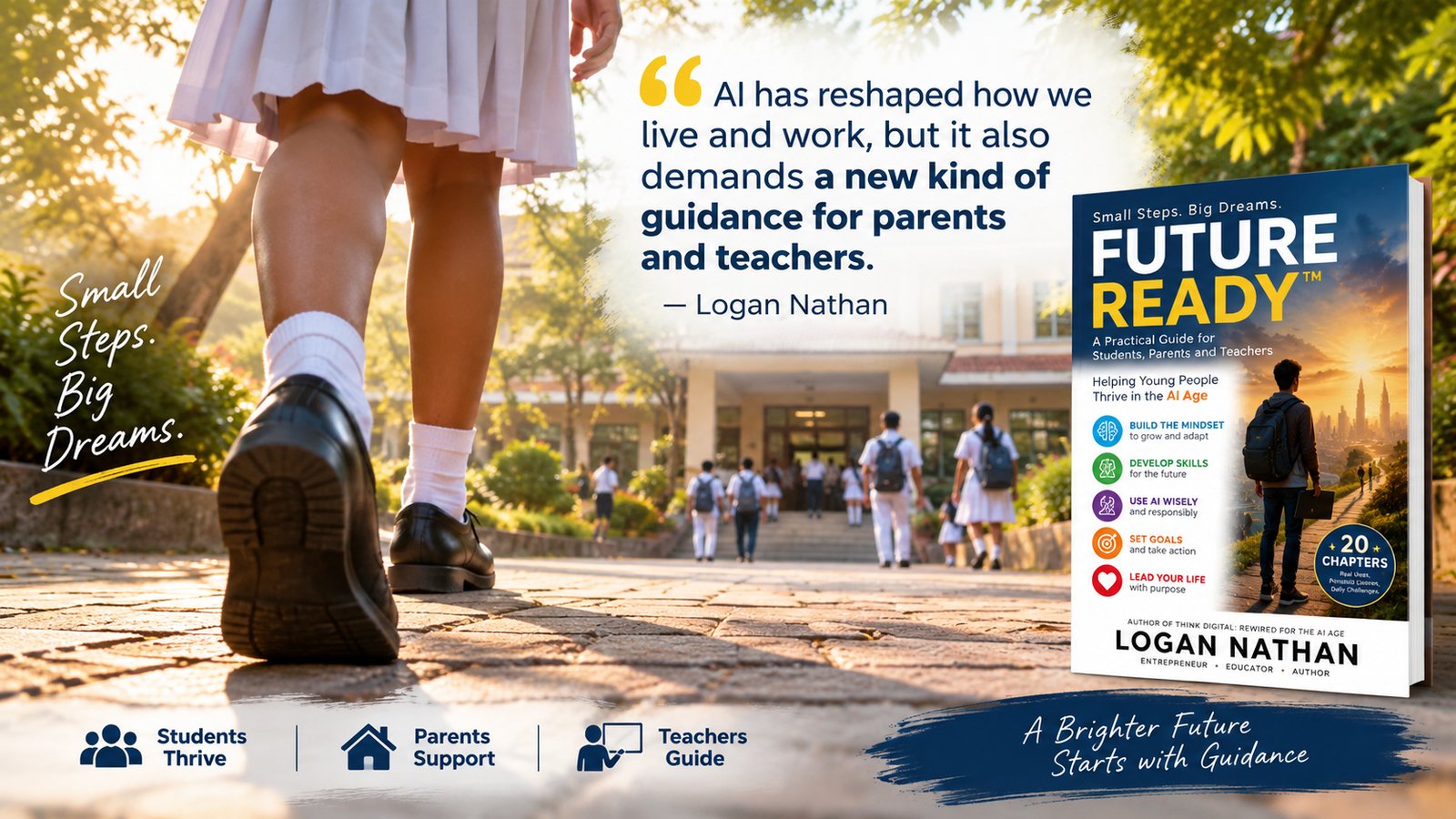
“AI has reshaped how we live and work, but it also demands a new kind of guidance for parents and teachers.” – Logan Nathan

Experience Perspective

Youth Technology Advisor

Drawing from my own experiences in guiding youth and parents through the technological landscape, I’ve observed the transformative power of small, consistent steps. This approach not only enhances individual growth but also builds a resilient community prepared for the future.

The Role of Small Steps in Achieving Big Dreams

Navigating the future isn’t about taking giant leaps but rather small, deliberate steps. This concept forms the core of my book, ‘Future Ready – Small Steps Big Dreams’. By focusing on micro-actions such as daily skill acquisition, individuals can build towards larger goals. For instance, spending just 15 minutes a day on AI literacy or data analysis can significantly enhance one’s professional adaptability.

Incorporating daily micro-actions builds confidence and fosters a continuous learning mindset, crucial for future readiness. It’s about developing a habit of lifelong learning and adaptability, which are essential for thriving in a digitally dominated landscape. Logan Nathan’s Two Year Journey of AI G.A.I.N – A Case Study offers insights into how small steps have significantly impacted my journey.

Case Study: Future Ready in Action

Real-world examples bring theoretical concepts to life. In my book, ‘Future Ready’, I share experiences from my own staff who, in their 20s, navigated the intricacies of integrating AI into their personal and professional lives.

  • Challenge: Adapting to AI technologies that evolved faster than expected.

  • Solution: Implementing small, consistent learning steps that allowed gradual mastery over time.

  • Results: Enhanced professional capabilities and readiness for future challenges.

These examples highlight the practicality of small steps in achieving significant progress, underscoring the importance of continuous learning in preparing for an AI-driven world.

Guiding the Next Generation

As parents and educators, our role has transformed from being the sole providers of knowledge to becoming facilitators of independent learning. Encouraging young people to take small steps in their learning journey is critical. This involves providing the tools and resources necessary for exploration, experimentation, and eventual mastery of new technologies.

For those in Australia and Sri Lanka, the educational landscape is particularly dynamic. Schools and communities must embrace the role of guides and mentors rather than gatekeepers of knowledge. By doing so, they empower youth to embrace change and transform their aspirations into achievements. In this regard, The Future Is Uncertain. Our Young People Can Still Be Ready. | Logan Nathan offers valuable insights into preparing youth for the uncertainties of the future.

Future Ready: Your Roadmap

As we look ahead, it’s clear that preparing for the future involves embracing small, continuous improvements rather than awaiting revolutionary changes. Begin by identifying areas for growth and take consistent action towards building skills in those domains. Whether it’s through formal education, online courses, or self-directed learning, the key is to start small and stay committed.

The journey towards future readiness is not linear; it is a path defined by curiosity, resilience, and adaptability. With the right mindset and resources, every small step taken today becomes a building block for a brighter, more secure future.

Next Steps for Aspiring Young Minds

Here’s a thought: what small steps can you take today to advance your future readiness? It might be a short online course in a new technology, a regular meeting with a mentor, or reading a book that stretches your thinking.

By focusing on incremental actions, you transform aspirations into tangible achievements. The potential is vast, and the opportunity is yours to seize.

Final Thoughts

The path to future readiness is paved with small, deliberate steps. In an AI-driven era, the ability to adapt and grow incrementally is more valuable than ever. By embracing this approach, we not only prepare for future challenges but position ourselves to achieve our greatest aspirations. Let’s take those steps together and build a future where every dream is within reach.

Frequently Asked Questions

Small steps involve consistent, daily actions focused on skill acquisition and adaptability. These can include learning new technologies or engaging with AI literacy practices.

Parents can support by providing resources, encouraging exploration, and fostering a mindset of continuous learning and adaptability.

Intergenerational collaboration helps bridge the technology gap, allowing older generations to share wisdom while learning modern skills from younger people.

AI influences future readiness by accelerating learning processes and requiring new skills, thus reshaping educational and professional landscapes.

Micro-actions are small, consistent steps that build confidence and contribute to long-term skill development, crucial for adapting to rapid technological changes.