
Key Takeaways
AI should act as a support mechanism, not replace the critical thinking process.
Teachers and parents should encourage students to articulate and apply their learning independently.
The integration of AI in education should focus on enhancing understanding, not just providing answers.
Key Answer
AI can enhance education by acting as a thinking partner rather than a substitute, ensuring students develop crucial skills like critical thinking and problem-solving.
In a rapidly evolving educational landscape, the critical question arises: If AI does all the lifting, who gets stronger? In classrooms worldwide, artificial intelligence is proving to be both a formidable ally and a potential crutch. While AI can enhance productivity and polish assignments, the challenge lies in ensuring it also strengthens students’ understanding and critical thinking.
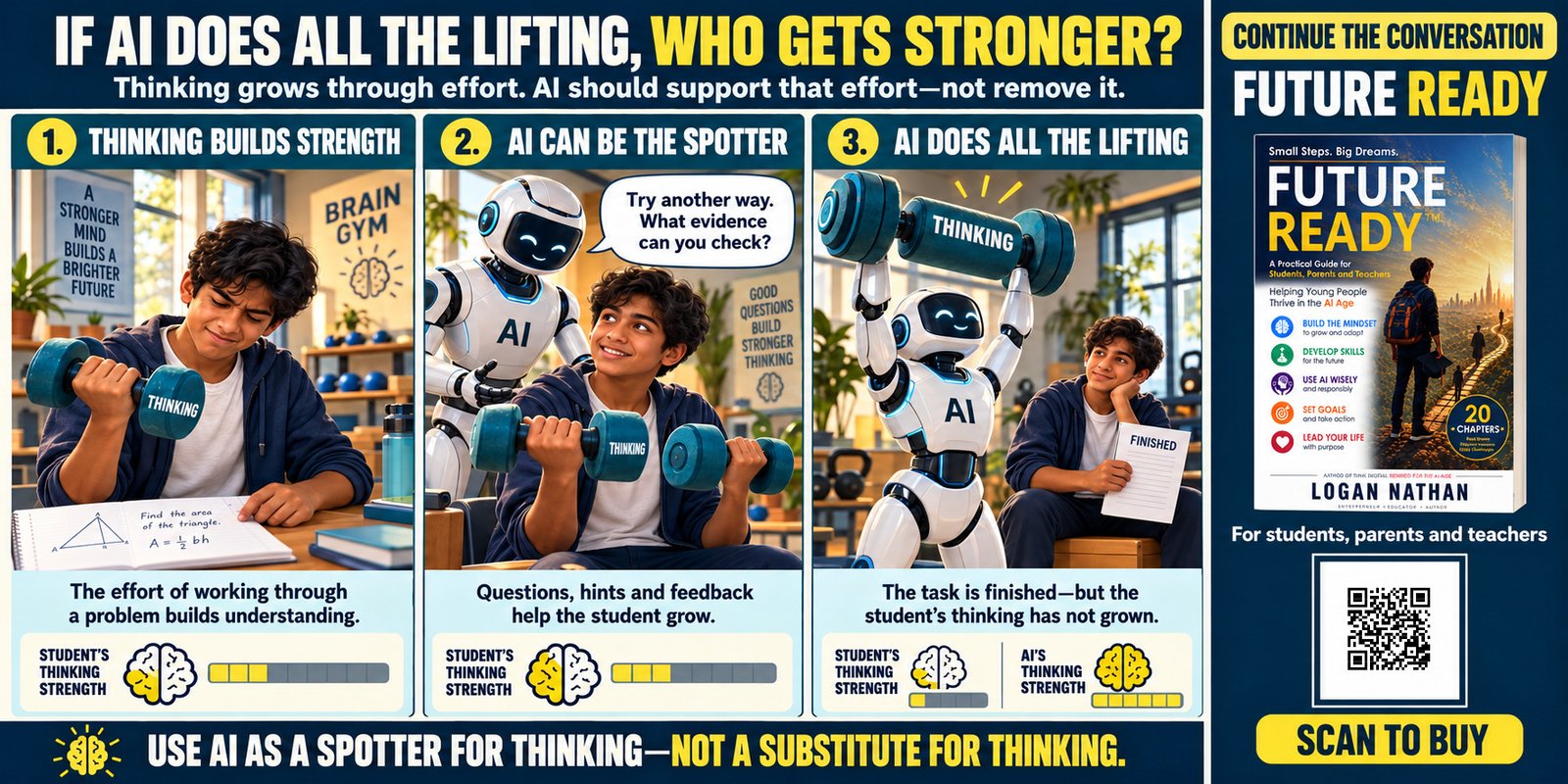
Thinking is Like a Muscle
Just like a muscle, your thinking develops through continuous questioning, attempts, mistakes, and retries. This process is essential for building robust cognitive skills. Without it, much like unused muscles, your ability to think critically atrophies. AI can help guide this process, but it should not replace the effort and struggle that foster true learning.
Finishing Work is Not the Same as Learning
Today’s AI tools can produce polished assignments swiftly. However, this completion isn’t synonymous with learning. When AI silently does the heavy lifting, it can inadvertently strip away the valuable effort required for deep understanding. It’s not just about the end result; it’s the journey of learning that solidifies knowledge.
Author’s Perspective
from first hand experience
In the educational domain, AI has the potential to transform learning experiences positively. However, it’s crucial that educators use AI to complement traditional teaching methods, focusing on fostering critical thinking and problem-solving skills. AI’s role should be as a supportive tool, guiding students but not doing the thinking for them.
Productive Struggle Still Matters
The moment before you reach the correct answer is often where the most significant learning occurs. This is the time when you engage with the material, connect the dots, and develop insights. AI should facilitate this process by offering clues and guidance, not by providing direct answers.
AI Should Act Like a Gym Spotter
Imagine AI as a spotter in a gym there to support and give you confidence without lifting the weight for you. A good spotter ensures you push your limits safely, encouraging you to lift more than you thought possible. Similarly, AI should empower you to explore challenging concepts independently.
What Healthy AI Use Looks Like
Healthy AI use involves leveraging technology for explanations, examples, questions, feedback, and exploring alternative approaches. It’s about using AI as a resource to enhance your learning journey, not as a shortcut to the end product. This approach ensures you develop a deeper understanding and can apply knowledge flexibly.
What Dependency Looks Like
Dependency on AI manifests when you begin to copy complete answers without comprehension, accept AI’s claims without verification, and find yourself unable to articulate your work. This scenario highlights the dangers of over-reliance and underscores the importance of maintaining a balance between AI assistance and personal effort.
A Simple Test for Teachers
Teachers can implement a straightforward test to measure genuine understanding: ask students to explain a concept in their own words, apply it to a new situation, and detail how they reached their conclusion. This ensures that AI is used as a tool for learning rather than a crutch.
A Useful Question for Parents
Parents can also play a crucial role by altering their approach. Instead of asking, “Have you finished your homework?” try asking, “What did you learn, and can you teach it to me?” This simple shift encourages deeper reflection and consolidation of knowledge.
A Four-Step Student Habit
To foster independence, students should adopt a four-step habit: think first, consult AI for support, verify the answer, and explain it themselves. This routine encourages self-reliance and ensures that students are genuinely internalising knowledge rather than merely parroting AI-generated content.
The Future-Ready Outcome
Students should graduate with the ability to think critically, use AI responsibly, and make informed decisions. This outcome not only benefits the individual but also society, as these skills are crucial for navigating the complex challenges of the future.
Case Study: Real World Learning Through AI
Early readers recognising the potential of AI to revolutionise learning. ‘Future Ready – Small Steps Big Dreams’ provides practical insights into how AI can be integrated into educational strategies without compromising critical thinking and problem-solving skills. For more details, visit Future Ready.
These real-world applications demonstrate AI’s role as a supportive tool in the educational landscape, ensuring that while assignments may be flawless, the learning journey is equally rigorous.
Frequently Asked Questions
AI should serve as a supportive tool that enhances learning by providing explanations and alternative approaches, without replacing the critical thinking process.
Teachers can ask students to explain concepts in their own words and apply them to new situations, ensuring that AI is used as a learning aid rather than a solution provider.
Dependence on AI can hinder the development of critical thinking and problem-solving skills, leading to superficial understanding and a lack of independent reasoning.
Parents can ask insightful questions like “What did you learn, and can you teach it to me?” to encourage students to reflect and articulate their understanding.
Students should think independently first, consult AI for guidance, verify the answers, and then explain the concepts in their own words to ensure comprehensive learning.
Sources & Further Reading
#AIinEducation #FutureReady #CriticalThinking